
The Problem
Why Sensitivity Alone Is Not Enough
A low LoD has little value if the assay is measuring the wrong target.
Many clinically important biomarkers require femtomolar or attomolar detection. But detecting a small signal is only meaningful when it originates from the intended target. Greater sensitivity can reveal the correct biomarker, or magnify signals caused by background, cross-reactivity, and poor antibody-pair selection.
The target is difficult to distinguish from background.
Low target abundance, nonspecific binding, blank variation, and matrix interference can obscure the true signal even when the instrument is highly sensitive.
The assay must distinguish the intended molecular form.
Isoforms, fragments, unmodified proteins, and related post-translational modifications may produce misleading signals when antibody specificity is insufficient.
Strong antibodies do not always form a strong pair.
Antibodies may compete for overlapping regions, create steric interference, dissociate too quickly, or perform differently when their capture and detector roles are reversed.
Antibody performance can change across batches and conditions.
Binding behavior may vary with antibody batch, buffer composition, reagent formulation, storage, handling, and sample environment.
The Solution
From Selection to Detection
Make the antibody decisions before scaling sensitivity
FOPPR provides the binding, specificity, and compatibility evidence needed to select antibody candidates before transferring them to FONLISA, Simoa, or another compatible detection platform. Unsuitable candidates can be excluded earlier, reducing downstream optimization and development risk. After assay development, FOPPR can continue to support antibody batch-to-batch comparison and reagent-condition monitoring.
Measure association, dissociation, and affinity: ka, kd, and KD.
Compare binding against selected potential cross-reactants to assess target recognition and specificity.
Use sequential epitope binning to identify candidates that can bind simultaneously under the tested conditions. Remove combinations showing competition or steric interference and prioritize compatible pairs for downstream development.
FOPPR can screen up to four antibodies sequentially on the same antigen-coated sensor in one uninterrupted run, without regeneration between injections.
See the compatibility workflowCompare antibody batches and evaluate binding under different buffers, formulations, storage conditions, and sample environments before transfer and during ongoing quality monitoring.
Transfer the selected pair to FONLISA, Simoa, or another assay platform. Optimize the platform-specific format, then establish LoB, LoD, and LoQ and assess recovery, precision, spike recovery across plasma dilutions, parallelism, and matrix interference.
FOPPR can continue to support antibody batch-to-batch comparison and reagent-condition monitoring after assay development.
Distinctive Capability
Up to Four Sequential Antibody Challenges on One Sensor
Conventional workflows often evaluate compatibility two antibodies at a time. FOPPR can challenge the same antigen-coated sensor with up to four antibodies sequentially in one uninterrupted run, preserving the binding history of the surface and reducing the need to restart the experiment after every pair. Each signal change indicates whether the newly introduced antibody can still bind to the progressively occupied surface.
Important distinction
This is sequential cumulative epitope binning, not simultaneous multiplexing. Alternative injection orders may be needed to identify which earlier antibody caused a blocked response and complete the compatibility map.
Conventional Pairwise Evaluation
Conventional methods commonly test ordered antibody pairs through separate assay cycles or a pairwise matrix.
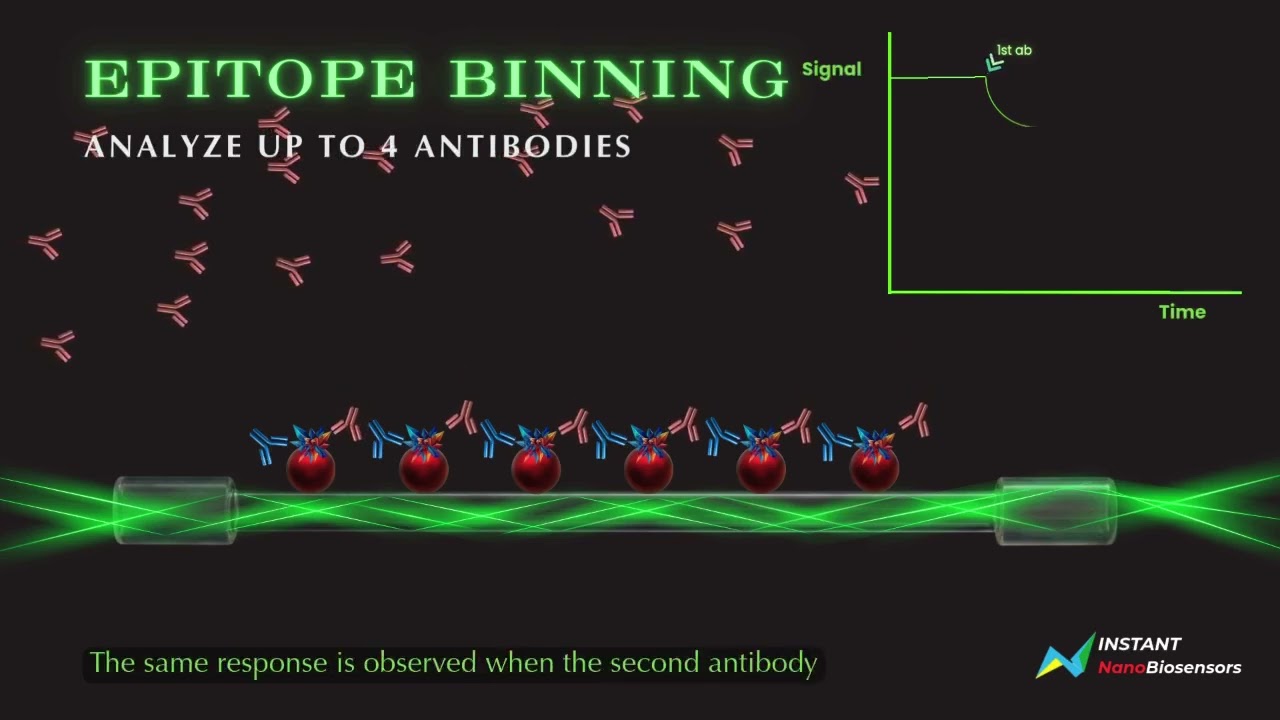 Watch the four-antibody sequential compatibility workflow on YouTube ↗
Platform Strategy
FOPPR Complements the Detection Platform You Choose
FOPPR does not require researchers to replace their preferred detection platform. It adds an upstream antibody-qualification step that can be used independently, combined with FONLISA, or integrated into workflows using Simoa or another compatible downstream technology.
Use FOPPR Independently
Characterize kinetics, assess selected cross-reactants, screen epitope compatibility, compare antibody batches, and evaluate reagent conditions.
Combine FOPPR + FONLISA
Connect antibody qualification with low-background, ultra-sensitive quantification in an integrated selection-to-detection workflow.
Transfer to Another Platform
Transfer qualified pairs to Simoa or another compatible assay platform for platform-specific optimization, sensitivity, throughput, or multiplexing.
Accessible Deployment
Compact, Decentralized Antibody Qualification
FOPPR brings real-time antibody characterization closer to the laboratories performing assay development. Its compact format supports qualification work beyond centralized core facilities.
Compact Deployment
Place real-time antibody analysis closer to discovery, translational, and assay-development teams rather than relying exclusively on a centralized characterization facility.
Accessible Real-Time Analysis
Observe association and dissociation behavior directly in a streamlined format designed to support practical antibody-development decisions.
Ongoing Quality Monitoring
Compare antibody batches, reagent formulations, buffers, storage conditions, and sample environments during development and after assay transfer.
Case Study 1
When a Strong Signal May Be the Wrong Signal
This study illustrates why antibody specificity should be resolved before an assay is pushed toward lower detection limits.
- Clinical need
- Lewy body disorders can be difficult to distinguish from Alzheimer’s disease due to overlapping clinical features. Although the target protein is a promising neuroinflammatory biomarker candidate, a previous Ella-based assay had an LLoD of 52.9 pg/mL, leaving multiple samples undetectable, and relied on polyclonal antibodies prone to batch variability and cross-reactivity.
- FOPPR finding
- Real-time kinetic analysis, sequential epitope binning, and tests against selected related proteins identified candidates with compatible binding behavior. Several alternatives reportedly produced greater responses to a homologous non-target protein than to the target protein under the tested conditions.
- Selection and transfer
- FOPPR data supported selection of the preferred antibody pair under the tested conditions, based on target binding, epitope compatibility, and low observed cross-reactivity. The pair was transferred to Simoa, where platform-specific optimization reportedly produced an LLoD of 0.618 pg/mL, approximately 86-fold lower than the previous assay.
- Takeaway
- FOPPR did not directly create the lower Simoa LLoD. It reduced the risk of optimizing an ultra-sensitive assay around antibodies with unsuitable specificity or pair compatibility.
Emer Phillips, University of Amsterdam and Amsterdam UMC. Manuscript in preparation, 2026.
Case Study 2
pTau217: A PTM-Defined Target at Sub-Femtogram Levels
pTau217 presents a different problem. The target is not simply tau at a low concentration; it is tau carrying a specific phosphorylation event at threonine 217. The antibody system must therefore distinguish the intended molecular form while retaining enough sensitivity for plasma measurement.
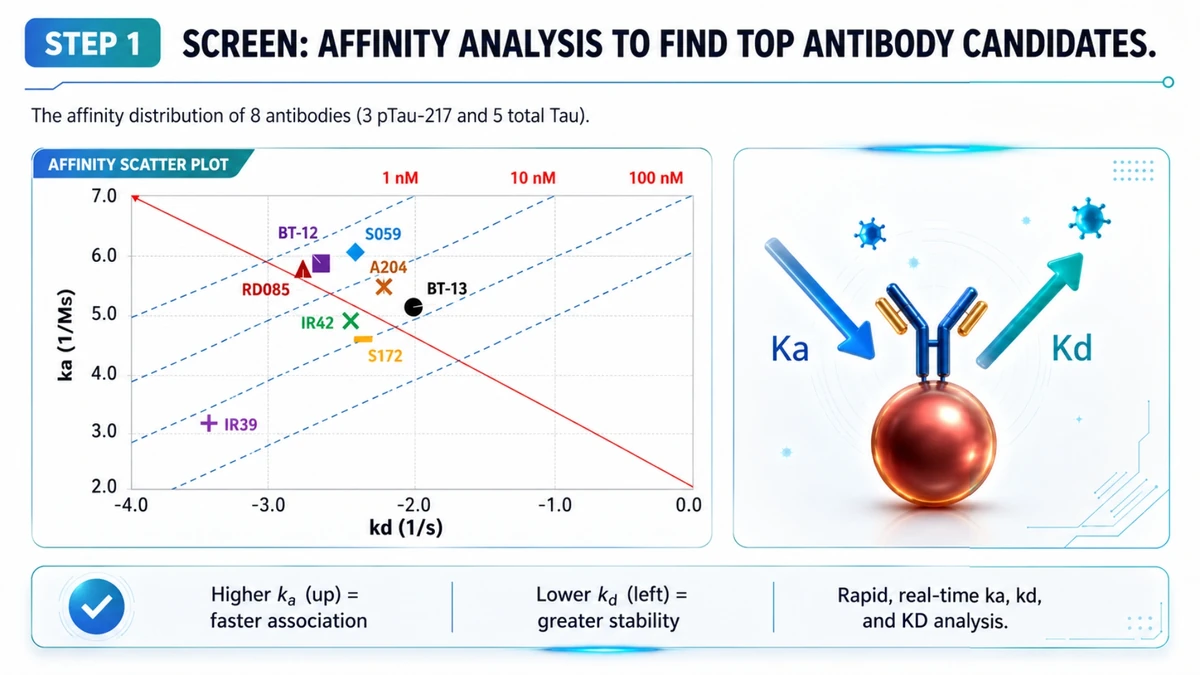
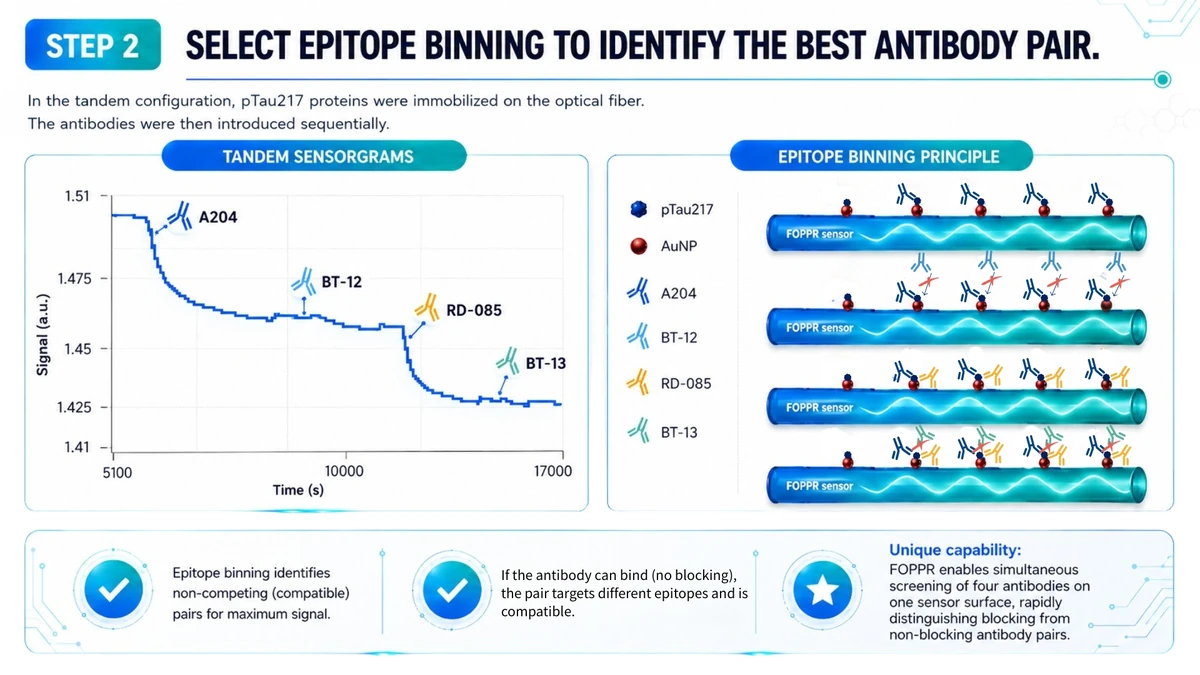
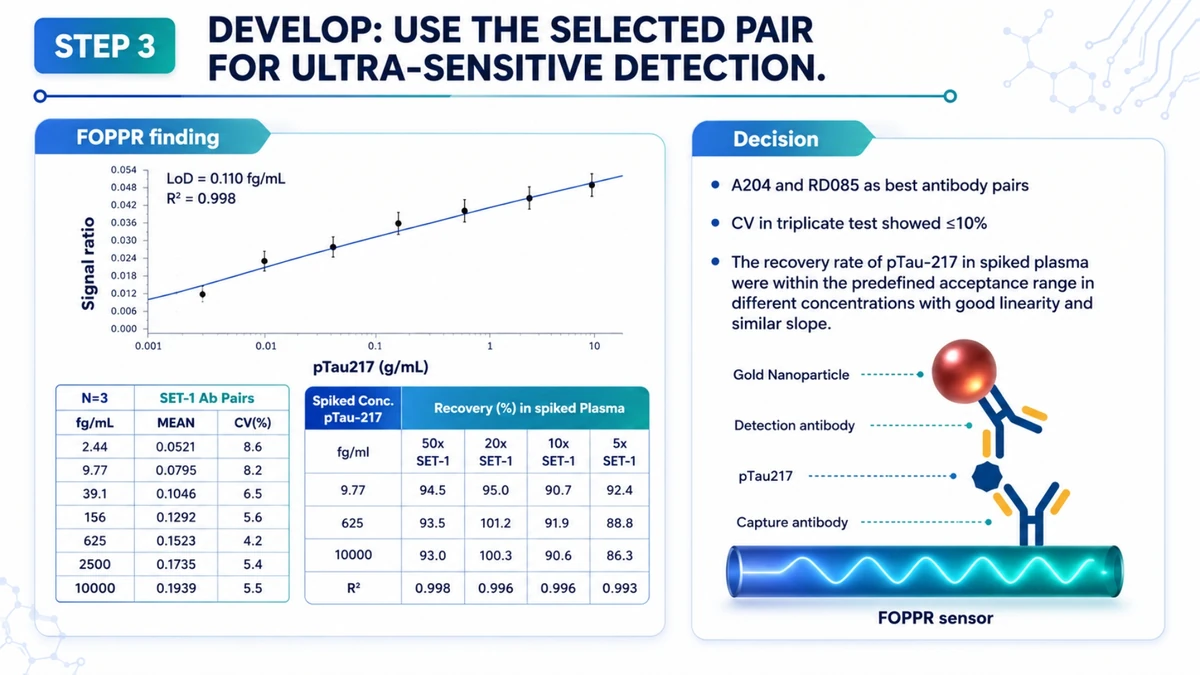
Andrew Ting-Chou Chang1, Venkanagouda Goudar2, Minnie Ting-Hsuan Tsao2, Tony Tsun-Chih Chung2, and Charlotte E. Teunissen3. Poster 2301, AD/PD™ 2026. 1Instant NanoBiosensors B.V., Utrecht, the Netherlands; 2Instant NanoBiosensors Co. Ltd., Taipei City, Taiwan; 3Amsterdam UMC, Amsterdam, the Netherlands.
Broader Applicability
Downstream Platform Example: Portable FONLISA Detection
FONLISA is one possible downstream destination for antibody pairs qualified through FOPPR. External evaluation of a prototype plasma neurofilament light chain assay illustrates the portability and broader biomarker applicability of this downstream platform. Madison Honey, a PhD candidate at Amsterdam University Medical Centre, discusses a study in which FONLISA differentiated control samples from samples from patients with Alzheimer’s disease and showed strong agreement with a single-molecule array assay, supporting further investigation of the platform for rapid biomarker testing.
 Watch the researcher perspective on FONLISA and plasma NfL ↗
Source: The Video Journal of Dementia
Interview recorded at the AD/PD™ 2024 Congress in Lisbon, Portugal.
Conclusion
Beyond Ultra-Sensitivity
Ultra-sensitive detection cannot compensate for an unsuitable antibody system. FOPPR provides the upstream evidence needed to evaluate binding kinetics, specificity risk, pair compatibility, and batch consistency before downstream optimization begins. Researchers can then use the qualified pair with FONLISA, transfer it to Simoa or another compatible platform, or continue using FOPPR for ongoing reagent monitoring.
From antibody uncertainty to assay decision
Qualify the antibodies before investing in downstream optimization.
Resolve antibody risk upstream, then choose the downstream detection workflow that best fits the required sensitivity, throughput, multiplexing capacity, and application.
Discuss Your AssaySources
References
- Instant NanoBiosensors. Epitope Binning: A Critical Step in Antibody Development. FOPPR application note.
- Instant NanoBiosensors. Neurofilament Light (NfL). Technical note describing affinity analysis, four-antibody testing on one sensor, and pair selection.
- The Video Journal of Dementia. Promising FONLISA test for ultrasensitive detection of plasma NfL in Alzheimer’s disease.
- Case-study source: Emer Phillips, University of Amsterdam and Amsterdam UMC. Manuscript in preparation, 2026.
- pTau217 case-study source: Andrew Ting-Chou Chang1, Venkanagouda Goudar2, Minnie Ting-Hsuan Tsao2, Tony Tsun-Chih Chung2, and Charlotte E. Teunissen3. Poster 2301, AD/PD™ 2026. 1Instant NanoBiosensors B.V., Utrecht, the Netherlands; 2Instant NanoBiosensors Co. Ltd., Taipei City, Taiwan; 3Amsterdam UMC, Amsterdam, the Netherlands.